
Independent rankings — we don’t sell software, and we list every tool’s weaknesses, not just its strengths.
Quick answer: For a small, self-managed HOA run by volunteer board members, PayHOA and HOA Express are the best-value picks — affordable, purpose-built for boards rather than enterprises, and simple enough that you don’t need a full-time administrator. Buildium is the better choice only if your association is large (100+ units), needs deep accounting, or overlaps with rental property management. Avoid enterprise platforms like AppFolio and CINC unless you’re a professional management company — they carry minimums and complexity a volunteer board doesn’t need.
Why self-managed HOAs need different software than management companies
Most “best HOA software” lists are written by the software vendors themselves, and most are aimed at professional management companies overseeing hundreds of associations. If you’re a volunteer treasurer or board member running a single 40-home community in your spare time, that advice points you toward platforms that are overkill — enterprise tools with $280–400 monthly minimums, full general ledgers you don’t need, and onboarding that assumes dedicated staff.
We’re independent. We don’t sell HOA software and have no product to push, so our only job is to tell you which tool genuinely fits your association, including where each falls short. We earn affiliate commissions when you sign up for some tools through our links — that keeps this site free — but it never changes our rankings, and you’ll find honest cons listed for every product below.
Self-managed and volunteer-board HOAs have a specific set of needs that enterprise-focused coverage ignores:
- Affordable, flat pricing — no per-unit fees that balloon, no five-figure minimums.
- Simple enough for volunteers — board members rotate; the software can’t require a specialist to run.
- Online dues collection — recurring and one-off assessments, with easy tracking.
- Homeowner self-service portal — so residents pay dues and submit requests themselves, reducing board workload.
- Violation and architectural-review (ARC) tracking — the board-specific workflows rental software doesn’t have.
- Document storage — CC&Rs, bylaws, meeting minutes, all in one place.
- Communication tools — mass email and text to owners, replacing manual newsletters.
This page ranks the tools that genuinely serve that board — not the management company with 50 communities.
How we evaluate
We weigh five things that matter to a self-managed HOA: real total cost (including per-unit fees and minimums the marketing pages downplay), simplicity for non-technical volunteer board members, the strength of dues collection and the homeowner portal, board-specific workflows (violations, ARC requests, document storage), and what verified board members report on G2, Capterra, and Software Advice. We weight everything toward small and mid-sized self-managed communities.
The top picks for self-managed HOAs
1. PayHOA — best for small self-managed associations
PayHOA is purpose-built for self-managed HOAs and is the tool we’d point most small volunteer boards to first. It handles the essentials well — automated dues collection, online payments, owner records, communication, document storage, and violation tracking — without the complexity of enterprise platforms. Pricing starts around $49/month for communities up to 25 units (billed annually), which is affordable and predictable for a small association.
Where it falls short: accounting depth. PayHOA handles financial basics well but doesn’t offer a full general ledger or detailed reserve accounting. Associations that require accrual-basis reporting or complex reserve tracking may outgrow it. For a typical small self-managed HOA, though, it’s an ideal formalization step up from email and spreadsheets.
Best for: Small HOAs under 25 units wanting simplicity and strong payment automation.
2. HOA Express — best for boards that want an included community website
HOA Express is designed specifically for self-managed associations and bundles something most competitors charge extra for: a community website. It covers violation tracking with photo uploads, architectural review requests, billing and payment collection, resident communications, and document management, with a self-service mobile-compatible resident portal that cuts board workload. There’s even a free tier covering unlimited pages, a calendar, and board information, with paid tiers for payment processing and advanced features.
Where it falls short: like other board-focused tools, it’s deliberately focused rather than enterprise-grade, so very large or financially complex associations may need more.
Best for: Self-managed communities that want management tools and a community website in one subscription.
3. Buildium — best for larger HOAs or mixed rental portfolios
Buildium is one of the most established names in the category. It was built for rental property management and expanded into community associations, so its strength is accounting — a full general ledger, accounts payable and receivable, bank reconciliation, and financial reporting. That makes it a strong fit for associations that need detailed accounting or work with a CPA expecting standard reports.
Where it falls short: complexity and cost for a small volunteer board. Pricing starts around $62/month (Essential), rising to $192 (Growth) and $400 (Premium), and the full AI suite sits behind that top tier. It’s a broader platform than most volunteer boards need.
Best for: Mid-to-large HOAs (100+ units), associations needing deep accounting, or boards managing a mix of HOA and rental units. Read our property management accounting software guide if accounting is your priority.
4. Condo Control — best all-rounder for condos and amenity-rich communities
Condo Control balances board-level usability with management-company scalability, which makes it a strong middle option. It’s particularly good for condos and communities with amenities — offering mass communication, amenity booking, maintenance tracking, virtual AGM voting, and an AI-assisted resident self-service portal. Pricing starts around $49/month for communities under 50 units.
Where it falls short: the feature breadth can be more than a simple single-family HOA needs, and it can feel complex for less technical board members.
Best for: Condo associations and amenity-rich communities prioritizing communication and resident engagement.
Tools to avoid as a small self-managed HOA
Several platforms top the vendor lists but are wrong for a volunteer board:
- AppFolio — typically a $280–400/month minimum plus per-unit fees, and often a 50-unit minimum. Built for management companies; cost-prohibitive for small communities.
- CINC Systems — built specifically for community-association management companies, not self-managed boards.
- Yardi Breeze — around $1/unit with a $400/month minimum, aimed at larger portfolios.
These are excellent at what they do — managing dozens of associations at scale — but for a single self-managed community, they’re overhead without proportional benefit.
Software vs. a management company
One clarification that trips up new boards: HOA software is not the same as hiring a management company. A management company runs operations on your behalf, usually for $10–20+ per unit per month. Software gives your board the tools to self-manage at a fraction of that cost — typically $45–135/month flat for a small community. If your board has the time and willingness, software is dramatically cheaper.
How to choose in 60 seconds
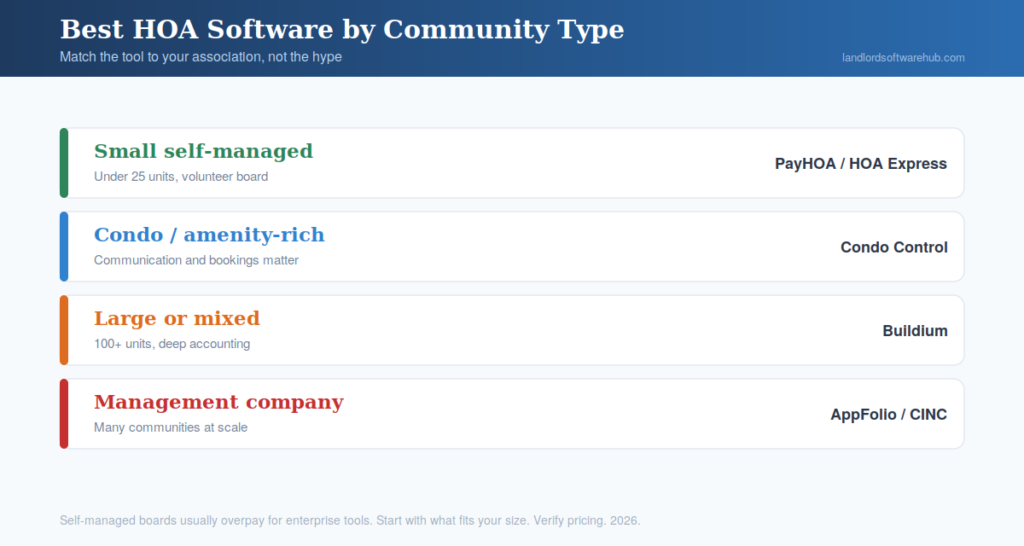
- Small self-managed HOA, want simple and affordable → PayHOA.
- Want a community website included → HOA Express.
- Condo or amenity-rich community → Condo Control.
- Large HOA or mixed rental portfolio needing deep accounting → Buildium.
- Professional management company with many communities → evaluate AppFolio, CINC, or Yardi.
Frequently asked questions
What is the best HOA software for a self-managed community?
For most small self-managed HOAs run by volunteer boards, PayHOA and HOA Express offer the best balance of affordability and board-specific features. Buildium is better for larger associations needing deep accounting. Enterprise platforms like AppFolio and CINC are built for management companies, not volunteer boards.
How much does HOA management software cost?
Small-community plans typically run $45–135/month flat. PayHOA and Condo Control start around $49/month; HOA Express has a free tier; Buildium starts around $62/month. Enterprise platforms carry $280–400/month minimums plus per-unit fees, which is why they don’t fit small associations.
Can a self-managed HOA use software without a property manager?
Yes — that’s exactly what self-managed HOA software is for. Platforms like PayHOA and HOA Express are built for volunteer boards to handle dues, communication, violations, and documents without hiring a management company, saving the association $10–20+ per unit per month.
Is there free HOA software?
HOA Express offers a genuinely free tier (community website, calendar, board information), with payment processing and advanced features on paid plans. Most other credible tools start around $45–49/month, as full dues collection and accounting are complex to provide for free.
Independent and reader-supported. Some links are affiliate links; we may earn a commission at no extra cost to you, which never affects our rankings. Pricing and features change frequently — always verify current details on each provider’s website. Last reviewed: 2026.