
Independent comparison — we don’t sell software, we just help you pick it.
Find your pick in 10 seconds
Tap what matters most to you as a small landlord:
Quick answer: If you manage 1–10 units and want a single recommendation, TurboTenant is the best free all-rounder for most small landlords, RentRedi is the best low-cost app if you want everything mobile, and Stessa is the best free tool if your priority is bookkeeping and taxes. The right pick depends on what you actually need — the comparison below shows exactly where each one wins and where it falls short.
Why small landlords need different software than big property managers
Most “best property management software” lists are written for companies managing hundreds of units. They recommend enterprise platforms like AppFolio and Buildium that start at $150–250/month and assume you have a dedicated office. If you own a handful of rentals and manage them yourself, that advice is actively wrong for you — you’d be paying enterprise prices for features you’ll never touch.
Small and independent landlords have a different set of needs:
- Low or no monthly cost — the software shouldn’t eat your rental margin.
- Rent collection — automatic online payments, reminders, and late fees.
- Tenant screening — credit, background, and eviction checks before you hand over keys.
- Listing and applications — get a vacancy filled without paying a leasing agent.
- Simple bookkeeping — track income and expenses so tax season isn’t a nightmare.
- A mobile app — because you’re not sitting at a desk; you’re at a job, at home, or at the property.
This page compares the tools that are genuinely built for that landlord — not the enterprise crowd. We don’t take a position on which company “should” win; we lay out the facts and let you choose.
How we evaluate (our methodology)
We’re an independent site. We’re not owned by any software company, and unlike many “review” pages you’ll find ranking on Google, we don’t have a product to push. We do earn affiliate commissions when you sign up for some tools through our links — that’s how the site stays free — but it never changes our rankings or what we say about a tool’s weaknesses. You’ll notice we list real cons for every product below, including the ones we recommend most.
We weigh five things: total real cost (including the fees the marketing pages hide), ease of use for a non-expert, the core feature set (rent, screening, leasing, accounting), the quality of the mobile experience, and what verified users actually say on review platforms like G2, Capterra, and Reddit.
Comparison at a glance
Our top 3 picks for small landlords
Prices change frequently and several tools charge tenant-side fees (application or ACH fees) that don’t show on the headline price. Always confirm current pricing on the provider’s site before signing up. Last reviewed: 2026.
| Tool | Best for | Starting price | Free plan | Rent collection | Tenant screening | Built-in accounting | Mobile app |
|---|---|---|---|---|---|---|---|
| TurboTenant | Best free all-rounder | $0 (Premium ~$8-12/mo) | Yes | Yes | Yes (tenant pays) | Basic | Mobile-friendly + app |
| RentRedi | Best mobile app | ~$9-20/mo | Trial only | Yes | Yes | Add-on | Yes - strong app |
| Stessa | Best for accounting | $0 (Pro ~$20/mo) | Yes | Yes (via banking) | Yes (via RentPrep) | Core strength | Yes |
| TenantCloud | Good free-tier option | ~$15-17/mo | Yes (limited) | Yes | Yes | Yes | Yes |
| Avail | Simple DIY leasing | $0 (Plus ~$9/mo per unit) | Yes | Yes | Yes | Basic | Mobile-friendly |
The top picks, explained
1. TurboTenant — best free all-rounder for most small landlords
TurboTenant is the tool we’d point a brand-new landlord to first. The reason is simple: the landlord side is genuinely free, and the free plan is actually usable rather than a crippled trial. You can list a property, syndicate that listing to Zillow, Apartments.com, Realtor.com and dozens of other sites, collect online rent, screen tenants, message renters, and handle applications without paying a subscription.
The business model is the key to understanding it: landlords use it free, and TurboTenant earns money from tenant-side fees (like application fees) and optional landlord Premium upgrades. That keeps the incentives mostly aligned — the platform has to stay good enough that landlords keep using it.
Where it wins: Free to start, excellent listing syndication, easy enough for a complete beginner, over a million landlords using it.
Where it falls short: Some things you might expect for free cost extra — state-specific lease agreements and certain premium perks sit behind the Premium plan or one-off fees. The accounting is basic; if bookkeeping is your priority, Stessa is stronger. And once you grow past roughly 10–15 units with staff, you’ll likely outgrow it.
Who should pick it: DIY landlords with 1–10 units who want the lowest cost and the least friction getting started.
2. RentRedi — best mobile-first experience
RentRedi is built around its mobile app, and that’s its main selling point. If you want to run your rentals from your phone — accept applications, collect rent, handle maintenance requests, get notifications — RentRedi does this better than most. Pricing is flat regardless of how many units or tenants you have, which is unusual and great if you’re growing: there are no per-unit charges piling up.
Pricing varies by commitment: roughly $9–12/month if you pay annually, up to around $20–30/month month-to-month (and RentRedi is sometimes bundled into a BiggerPockets Pro membership). Always check the current number.
Where it wins: Best-in-class mobile app, flat pricing with unlimited units, all features on every plan, strong automation.
Where it falls short: No free plan (only a trial). The first rent payment from a new tenant can take 5–7 business days to clear as a fraud-prevention measure — plan around it. Accounting is an add-on, and some users report the initial bank-linking setup is fiddly.
Who should pick it: Landlords who live on their phone and want one flat price as their portfolio grows.
3. Stessa — best free tool for accounting and taxes
Stessa approaches the problem from the money side. Think of it as bookkeeping software built specifically for rental property — you connect your bank and card accounts, and it automatically imports and categorizes transactions by property, then generates tax-ready reports (including Schedule E). The free tier is genuinely generous: unlimited properties, bank linking, auto-categorization, and financial reports at no cost. It’s backed by Roofstock, so it’s financially stable.
Where it wins: Outstanding free accounting and tax reporting, unlimited properties on the free plan, clean dashboards, automatic transaction categorization that learns over time.
Where it falls short: It started as a financial tracker, so the property-management extras (rent collection, leasing) are newer and less complete than dedicated tools. Rent collection generally pushes you toward Stessa’s own banking, which some users dislike. Bank-feed sync glitches and inconsistent support are recurring complaints.
Who should pick it: Landlords whose biggest pain is bookkeeping and taxes, and who may pair Stessa (for money) with another tool (for leasing/rent).
How to choose in 60 seconds
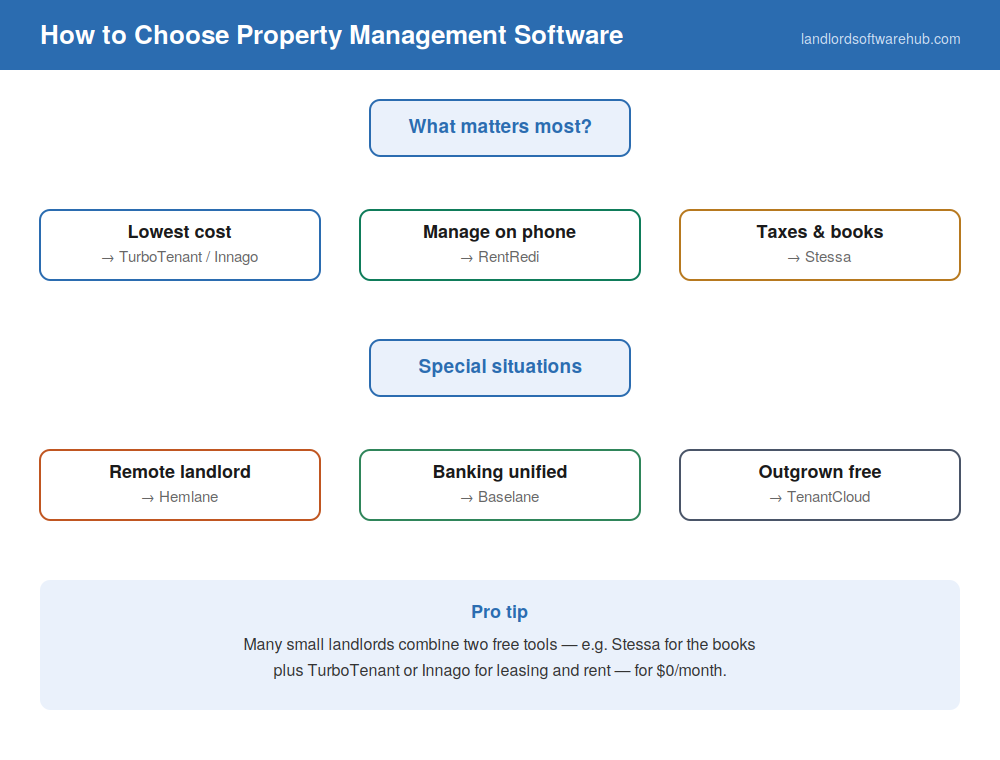
- You want the lowest possible cost and you’re new → start with TurboTenant (free).
- You want to run everything from your phone → RentRedi.
- Your nightmare is tax season and tracking expenses → Stessa (free).
- You want a free tier but TurboTenant didn’t fit → try TenantCloud or Avail.
Many small landlords end up using two tools — for example, Stessa for accounting plus TurboTenant for listing and rent. That’s a perfectly reasonable setup and costs nothing.
Frequently asked questions
What’s the best free property management software for small landlords?
TurboTenant (best free all-rounder) and Stessa (best free for accounting) are the two strongest genuinely-free options. Both let you manage real workflows without a subscription, though both earn money in other ways — TurboTenant through tenant-side fees, Stessa through its banking and Pro upgrade.
How much should a small landlord expect to pay?
Many small landlords pay $0/month in subscription fees by using a free tool, and instead pay occasional per-use costs like tenant screening (often passed to the applicant). Paid plans for small-landlord tools typically run from about $9 to $30/month. Watch for tenant-side ACH or application fees that don’t appear on the headline price.
Do I need property management software at all if I only have one unit?
Even with one rental, free software saves you real time and risk: online rent beats chasing checks, proper screening reduces bad tenants, and automatic expense tracking makes taxes far easier. Since the best starter options are free, there’s little downside to using one.
Is it safe to link my bank account to these tools?
The major tools use bank-grade encryption and connect through Plaid, a secure intermediary used by thousands of financial apps, so your bank login isn’t stored by the software itself. As always, use a strong unique password and enable two-factor authentication where offered.
This guide is independent and reader-supported. Some links to software are affiliate links, meaning we may earn a commission at no extra cost to you if you sign up — this never affects our recommendations or the cons we list. Pricing and features change often; verify current details on each provider’s website.