
Independent guide — we don’t sell software, and we break down the real costs, including the fees vendors don’t advertise.
Quick answer: Property management software for small landlords ranges from $0 to about $60/month, and many small landlords pay nothing. Free tools (Innago, TurboTenant, Stessa) cover rent collection, screening, and accounting at $0, earning money from tenant-side fees instead. Paid all-in-one platforms typically run $20–60/month for a small portfolio, while enterprise tools (AppFolio, Yardi) start at $280+/month with per-unit fees. The real cost often hides in ACH and payment fees, not the monthly price.
The short version: what you’ll actually pay
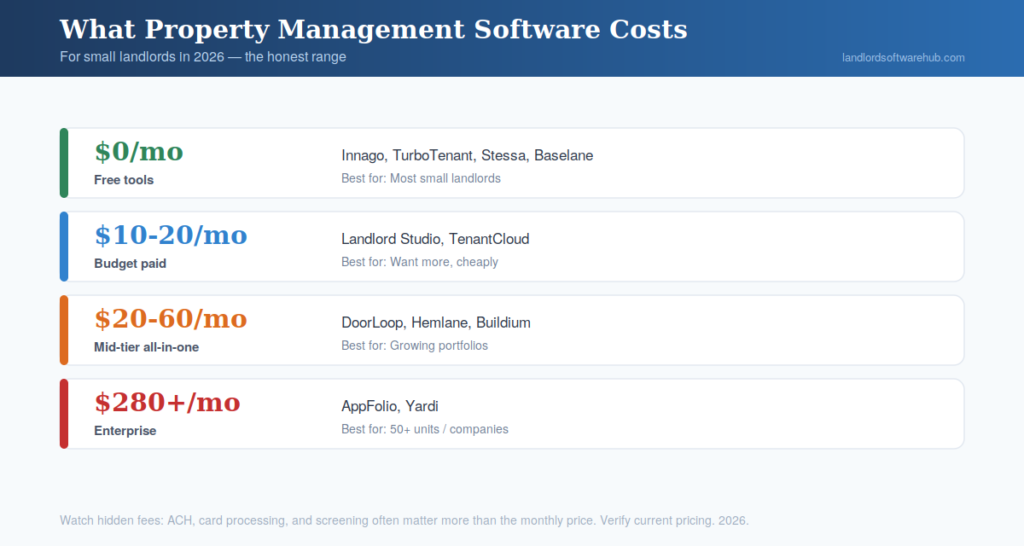
For a small landlord (1–20 units), here’s the honest range in 2026:
- $0/month — genuinely free tools (Innago, TurboTenant, Stessa, Baselane). You pay nothing; tenants may pay small fees.
- $10–20/month — budget paid tools (Landlord Studio ~$12, TenantCloud ~$15–17).
- $20–60/month — mid-tier all-in-one platforms (DoorLoop ~$49, Hemlane ~$30+, Buildium ~$62 Essential).
- $280+/month — enterprise platforms (AppFolio, Yardi), usually with a 50-unit minimum. Not for small landlords.
Most small landlords never need to spend more than $0–50/month, and many spend nothing.
We’re independent — we don’t sell software — so this breaks down real costs including the fees that don’t show on the headline price. We earn affiliate commissions through some links, which keeps this site free and never affects our guidance. See our affiliate disclosure.
The pricing models, explained
Software costs come in a few shapes, and understanding them tells you where your money actually goes:
Free (tenant-pays or banking-funded). Tools like Innago and TurboTenant are free to landlords because they earn from tenant-side fees (card processing, screening) or, like Baselane, from banking activity. Best for small landlords watching costs.
Flat monthly fee. A fixed price regardless of units (e.g., RentRedi, some DoorLoop tiers). Predictable, and increasingly good value as you add units since the price doesn’t climb.
Per-unit pricing. A base fee plus a charge per unit (e.g., ~$1–2/unit/month on some platforms, or Avail’s $9/unit Plus tier). Cheap at low unit counts, but scales up as you grow.
Enterprise (base + per-unit + implementation). Platforms like AppFolio charge a monthly minimum ($280–400) plus per-unit fees, sometimes with setup costs. Built for management companies, cost-prohibitive for small landlords.
The hidden costs vendors don’t advertise
The monthly price is only part of the story. Watch for:
ACH transfer fees. Some “free” tools charge per rent payment — Avail charges $2.50 per ACH on its free tier, while Innago’s ACH is free for both sides. Across a year, this adds up.
Credit/debit card fees. Card rent payments typically carry a ~2.75–2.9% fee, usually passed to the tenant. Fine if your tenants use ACH, costly if they use cards.
Tenant screening. Usually $30–55 per applicant, most often paid by the applicant — but confirm who pays.
Paywalled features. Some tools advertise “free” but put e-signatures, faster payouts, or state-specific leases behind a paid tier. A $99/month plan needing $200 in add-ons can cost more than a $250/month all-inclusive plan.
The lesson: a low monthly fee with high per-transaction fees can cost more than a flat-rate alternative. Always total the real cost for your situation, not the headline price.
What should a small landlord actually pay?
Honestly? For most landlords with a handful of units, $0. The free tools genuinely cover the essentials:
- Rent collection + leasing + screening → Innago or TurboTenant (free).
- Accounting + taxes → Stessa (free).
- Combine two free tools and you have a complete operation at $0/month.
You should consider paying when you need something free tools don’t offer well: deep double-entry accounting (Buildium), a polished all-in-one experience (DoorLoop), hands-off maintenance coordination (Hemlane), or scale past ~20 units where paid platforms’ efficiency justifies the cost.
Cost by portfolio size
- 1–5 units: $0. Free tools are all you need.
- 5–20 units: $0–50/month. Free tools still work; consider a paid all-in-one (DoorLoop, TenantCloud) if you want everything in one polished place.
- 20–50 units: $50–200/month. Paid platforms (Buildium, Rentec Direct) start earning their cost through automation and accounting depth.
- 50+ units: $280+/month. Enterprise tools (AppFolio, Yardi) become viable as per-unit costs spread across the portfolio.
Frequently asked questions
How much does property management software cost for a small landlord?
Most small landlords pay $0–50/month, and many pay nothing. Free tools (Innago, TurboTenant, Stessa) cover the essentials; paid all-in-one platforms run roughly $20–60/month; enterprise tools start at $280+/month but aren’t meant for small portfolios.
Is there genuinely free property management software?
Yes. Innago, TurboTenant, Stessa, and Baselane all offer genuinely free tiers for landlords. They earn from tenant-side fees or banking rather than charging you a subscription. See our best free property management software guide.
Why do some tools cost $280+/month?
Those are enterprise platforms (AppFolio, Yardi) built for professional management companies with large portfolios. They carry monthly minimums and often a 50-unit minimum, spreading cost across many units. For a small landlord, they’re overkill and overpriced.
What hidden fees should I watch for?
ACH transfer fees (some tools charge per payment; Innago’s are free), credit-card processing fees (~2.75–2.9%), tenant screening ($30–55, usually applicant-paid), and features locked behind paid tiers. Always total the real cost for your situation, not just the monthly price.
Is paid software worth it over free?
Only if you need what free tools lack: deep accounting, a polished all-in-one experience, hands-off maintenance coordination, or scale past ~20 units. For most small landlords, free tools genuinely suffice — don’t pay for capacity you won’t use.
Independent and reader-supported. Some links are affiliate links; we may earn a commission at no extra cost to you, which never affects our guidance. Pricing changes frequently — always verify current details on each provider’s website. Last reviewed: 2026.